Trump clears the Strait

The Speaker of Iran’s Parliament stated that the American side was unable to win the trust of the Iranian delegation in the latest round of negotiations.

Mohammad Bagher Ghalibaf wrote in a post on the social media platform X that the Islamic Republic of Iran had emphasized goodwill and the necessary political will prior to the talks; however, due to the experience of two past wars, there is no trust toward the opposing side.

He added that members of the Iranian delegation, known as “Minab 168,” had put forward forward-looking initiatives, but the other side ultimately failed to earn the delegation’s confidence.

Ghalibaf continued that the United States, during the negotiations, came to understand Iran’s logic and principles and must now decide whether it is capable of gaining Iran’s trust.

The Speaker stressed that Iran is pursuing a “power-based diplomacy” alongside other approaches, including military countermeasures, to secure the nation’s rights, and will not retreat from efforts to consolidate the achievements of the 40-day national defense.

He also expressed appreciation for Pakistan’s role in facilitating the negotiation process, describing the country as a “friend and brother.”

In conclusion, Ghalibaf thanked public support and the efforts of the negotiating team during the intensive 21-hour talks, reaffirming Iran’s commitment to defending its national interests.


Irans opinions no longer matter. The KID gloves have come off. No more pulling punches and taking it easy on you. These light little beatings the U.S has been administering to you are about to turn into real man beatings now. The days of treating you like a pack of silly little kids are OVER,
 
How did you arrive at that nonsensical conclusion?

Venezuela does not “more than make up the gap” from Iran’s output. Iran’s crude production (~3.3 mb/d) is about 3× Venezuela’s current level. Even optimistic near-term forecasts see Venezuela adding only a few hundred thousand b/d in the next 1–2 years with investment and sanctions relief. That's not enough to offset or exceed Iran’s contribution. Longer-term potential (e.g., back toward 1.5–2.5 mb/d) would take years and tens of billions in investment, not an immediate replacement.

Do they not have newspapers in West Hollywood?


In short, this appears to be rhetorical exaggeration (possibly from political commentary downplaying Iran’s role or hyping Venezuela’s potential). The data from EIA, OPEC, IEA, and industry sources shows neither part of the claim is accurate.

The real issue is logistical.

The Persian Gulf region (primarily Saudi Arabia, Iran, Iraq, the United Arab Emirates, Kuwait, and Qatar) cannot be simply “replaced” as a source of oil and fertilizers without severe global economic distress because it supplies an outsized, low-cost share of both commodities that the rest of the world cannot quickly or affordably replace. This dominance stems from geology (vast, easy-to-produce reserves), infrastructure (export terminals and the Strait of Hormuz chokepoint), and economics (some of the world’s cheapest feedstock). A sudden cutoff would trigger massive price spikes, inflation, reduced agricultural output, and broader supply-chain chaos.

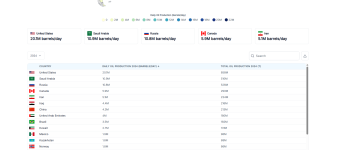
The USA is by far the largest producer of oil in the world.

Your pathetic propaganda is laughable, Bob.

1776009825954.png
 
CENTCOM says they were there to begin setting conditions to remove mines.

Why aren't any supertankers crowding into the Strait today?

Why did two suddenly reverse course and flee?

What are you yapping about Bob?

The USS Gerald Ford is setting up a blockade of your brutal theocratic dictatorship.

We're going to starve you out.

Not a damn thing you can do about it.
 
Do they not have newspapers in West Hollywood?


The USA is by far the largest producer of oil in the world.

Your pathetic propaganda is laughable, Bob.

View attachment 80909


Replacing even a fraction of Gulf oil would require years of investment in higher-cost alternatives (more U.S./Canadian shale, Brazilian pre-salt, or Venezuelan heavy oil).

Short-term, prices would surge (as seen in recent disruptions pushing crude above $100–110/barrel), raising costs for gasoline, diesel, jet fuel, plastics, chemicals, and electricity.

Global GDP would take a hit from higher energy inflation; developing economies dependent on Gulf imports (much of Asia) would suffer most.

Strategic petroleum reserves help temporarily but are finite and not a long-term fix.

This is not sustainable for America or Israel.
 
What are you yapping about Bob?

The USS Gerald Ford is setting up a blockade of your brutal theocratic dictatorship.

We're going to starve you out.

Not a damn thing you can do about it.


The Ford is a tempting target, and it's been deployed for 11 months already. Like its namesake, it is prone to falling.

 
The Ford is a tempting target, and it's been deployed for 11 months already. Like its namesake, it is prone to falling.

Our carriers wont be hit. Heres why.........


Tehran
a nuclear explosion with a huge mushroom cloud coming out of it

a large explosion with a chain link fence visible in the background
 
Back
Top